Four Extreme Winter Storms, No Data: How the Government Left Communities Flying Blind
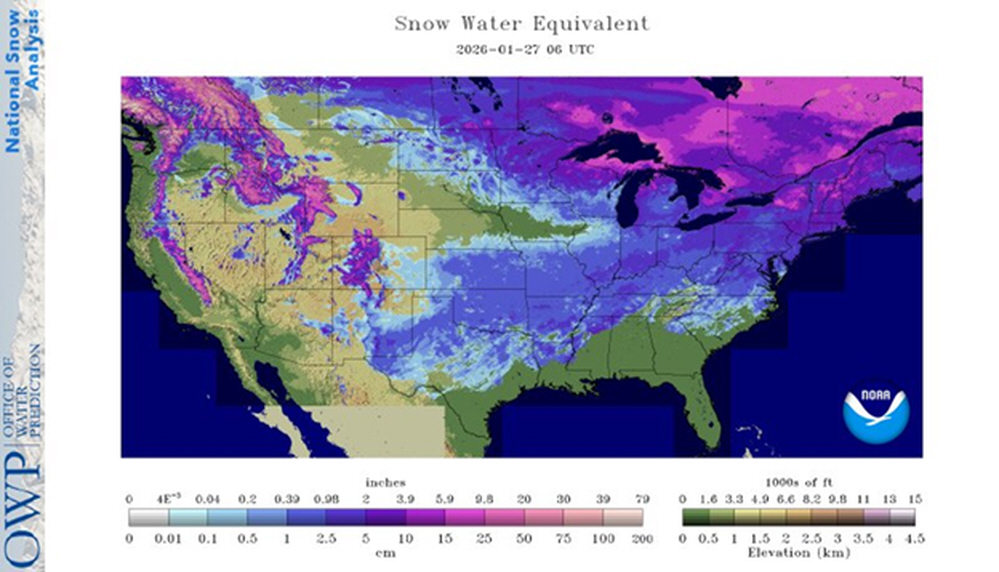
One of only 27 Category 5 “Extreme” blizzards recorded since 1900 tore through the United States in March. And NOAA, the federal agency that spent 45 years measuring exactly this kind of disaster, went dark in January 2025.
The Extreme Mid-March Blizzard & Cold Snap (March 13–17) not only rated as a Category 5, the most Extreme snow category on the Regional Snowfall Index (rated zero through five), it ranks as the eighth worst blizzard since 1900. The storm was also reported to have brought 51 tornadoes and caused power outages for around 500,000 homes, with three fatalities. It was the fourth Winter Storm disaster of 2026.
At the same time the devastating blizzard was striking the eastern half of the country, the West was breaking records in a heat wave that started March 16 and continued for 11 days through March 26. March also included 191 tornadoes in a month that averages 80.
From extreme winter cold to extreme summer heat happening in one day just after the first day of spring is alarming.
Three Extreme Winter Storms started before this most Extreme event. The first was a large and Extreme Winter Storm Fern (Jan. 23–27), with estimated impacts: damage more than $4 billion and possibly significantly higher (2026 USD), 174 fatalities.
Then came a comparatively less severe Pre-Groundhog Day nor’easter, a Category 2 “Significant” event (Jan. 31–Feb. 2). It involved damage that has yet to be determined but included 13 fatalities and up to 22.3 inches of snow.
Then the 2026 Late February Blizzard (Feb. 20–24) showed up as a Category 3 “Major.” A powerful, historic and severe blizzard caused extensive impacts including 30 fatalities, a maximum snow depth of 37.9 inches and unknown damage costs.
The 2026 Winter Storms have clearly caused worse impacts than those in 2025. Yet the federal agency responsible for tracking them, the National Oceanic and Atmospheric Administration or NOAA, stepped back from that mission at precisely the wrong moment. The data stopped on the first day of January 2025, according to the federal NESDIS May 9, 2025, notice of changes.
The trend is in the numbers
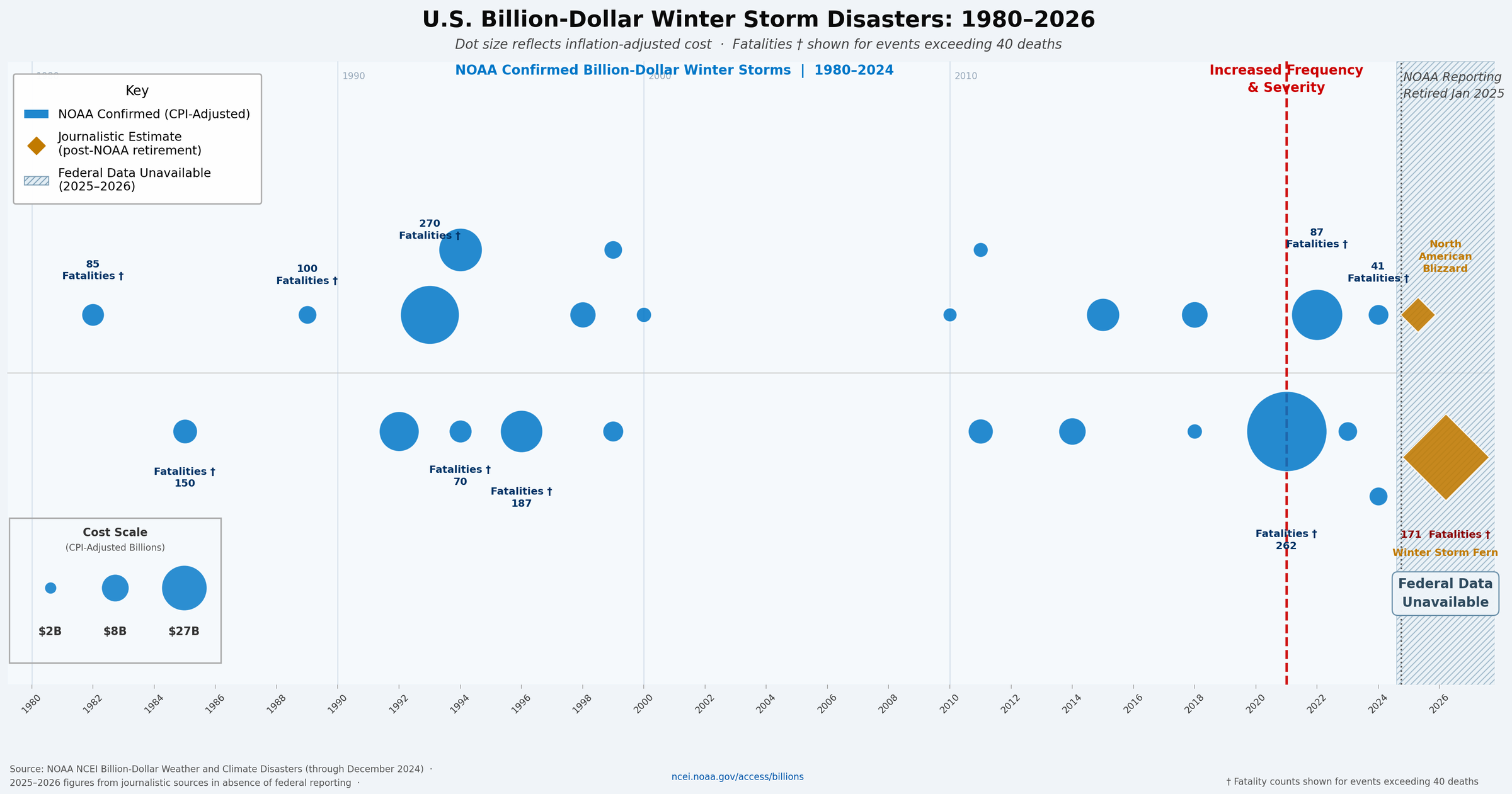
For 45 years, NOAA tracked “Billion Dollar Weather and Climate Disasters” as a standardized federal database defining and quantifying the impacts of Winter Storm events, one of seven weather related concerns. The events all cross the Billion Dollar threshold, a normalized economic impact metric, which is considered an Extreme category. The event impacts draw on Snow Index Categories and they have related fatalities and connect to definable risk categories.
Government reports are important for their science-based processes and consistent data-gathering methods that provide comparable data year-to-year.
The data shows 19 Extreme Winter Storms occurred between 1980 and 2020 — roughly one every two years. Between January 2021 and December 2024, five Extreme Winter Storms occurred, a rate of 1.25 per year — more than double the previous 40-year average.
The financial toll tells an equally stark story. From 1980 to 2020, Billion Dollar Winter Storms cost an average of $1.56 billion per year. From 2021 to 2024, that figure rose to $8.3 billion per year — more than five times higher. Two of the costliest Billion Dollar Winter Storms on record occurred within that four-year window: the Central and Eastern Winter Storm of December 2022 and the Coast-to-Coast Winter Storm and Cold Wave of February 2021.
Both Winter Storm Fern and the Mid-March Blizzard are strong Billion Dollar storm candidates. The 2026 Late February Blizzard is also a strong candidate for that designation pending better data. It is possible but less likely the Pre-Groundhog Day nor’easter may qualify; it is only classified as a Category 2 “Significant” snow event despite 13 fatalities.
If even three of these four storms qualify as Billion Dollar disasters, 2026 would already be running at approximately six times the historical annual rate for such events compared with the 40-year period ending in 2020. If all four storms qualify, the rate would exceed eight times that baseline.
It looks like a clear case for three possibly four qualifying Billion Dollar Disaster events in 2026 — at least it would be if the government were paying attention.
In the absence of NOAA reporting, sources such as Wikipedia and reputable journalism are filling the gap — a circumstance that speaks for itself and one that creates inconsistent information.
The details of the Jan. 23–27 Winter Storm Fern reporting show the need for consistent analysis. A reputable weather service was reporting in real time during the storm and anticipated costs of more than $100 billion. A combination of reports from reputable insurance analysts put the cost estimate at up to $13.4 billion, and Wikipedia puts the damage at more than $4 billion. Those figures would all be based on different information, including different types of damage and different estimating methods.
Any of these figures would qualify it as a Billion Dollar disaster. The cost at $13.4 billion would rank Fern as the third costliest Winter Storm on record.
No official federal data exists to confirm or refine those figures.
A public safety obligation
These risks are not theoretical. They are already reaching communities across the country through collapsed power grids, damaged infrastructure, disrupted transportation, devastated crops and livestock, and interrupted essential services. The consequences fall hardest on those least able to absorb them. Compounding the problem, recent budget changes have reduced federal disaster relief funding — cutting the safety net at the very moment it is most needed.
The data infrastructure that emergency managers, infrastructure planners, and local communities depend on has been reduced at the very moment the science demands it be expanded. Restoring and strengthening federal Extreme weather reporting is not a political request. It is a public safety requirement.
That urgency belongs to elected officials at every level of government — and to the voters who put them there. Ours is a “Democratic Republic” — a system defined by elected representatives who are accountable to the people they serve. In such a system, protecting citizens from foreseeable harm is not optional governance. It is the obligation the entire system rests on.
About the author
RB Sydney
RB Sydney is a science writer and analyst based in Northern California. He holds an M.S. in International Agricultural Development from UC Davis and a B.A. in Biological Science. He has more than 50 years of field experience in agricultural and environmental science. The California Governor’s Office published RB Sydney’s early analytical work with resent work published in regional and nonprofit publications including for the North Coast Environmental Center. He is the author of several books, including Energy and EV Secrets. He has tracked bioregional conditions across North America since 1972.